.post img { border:5px solid #d2d2d2; padding:2px; }

Sunday, 6 March 2016

Quicksand

Danger Quicksand!


The word spread quickly through the playground. We were getting messy again! 

The first task was to make the quicksand recipe, add some food colouring (just for fun) and then take it outside and play with it. Yes, PLAY with it. The kids could not believe their ears but they were amazed at what they discovered while doing this. The cries of 'look at this!' echoed all around us as everyone was busy exploring the physical properties of their 'quicksand'.


We then explored a concept cartoon and had small group discussions to see if the students could reach a consensus based on their experiences with their quicksand. 


They couldn't agree so predictions and sketches were made on how to investigate which of the three scenarios would be the most successful to escape if you were caught in a pool of quicksand. Then using plasticine peolple and quicksand students set about trying to prove their theory was correct.

Swimming fast didn't work either
Calmly lying still and floating wasn't successful


There were some very smug people once we all shared our outcomes and discussed how best to move through this Non-Newtonian fluid. 

Would you know how to escape from quicksand?

What the kids said about today:

Wednesday, 2 March 2016

Viscosity

Viscosity

Interestingly no one had heard of this word before but plenty of suggestions came up of what it sounded like or reminded students of but from experience I know that kids enjoy playing with marbles and getting messy with gooey stuff.

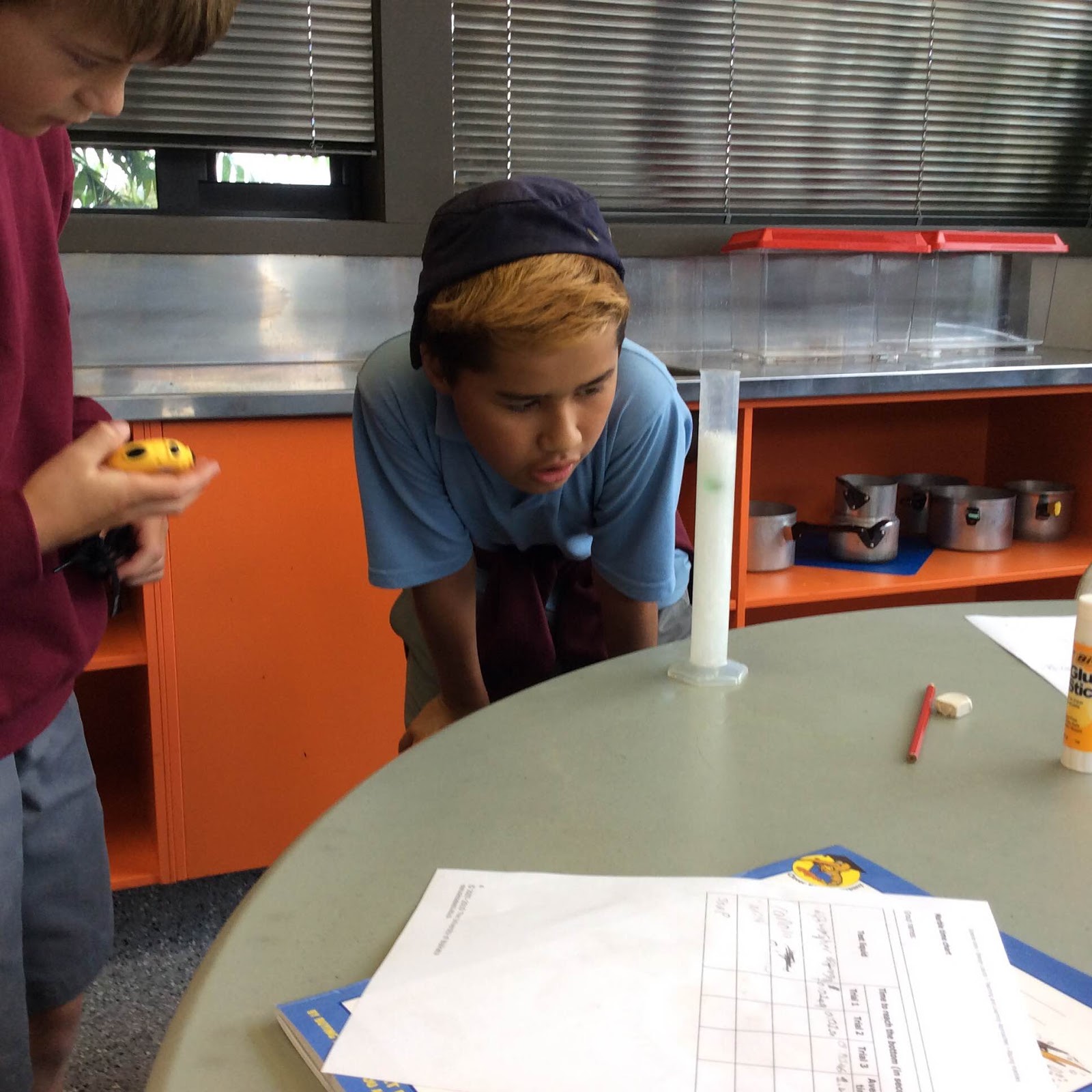
We organised ourselves and set all our equipment up. As I explained the experiment students made predictions about which liquid the marble would pass through the fastest. (Word had obviously spread because in the first class we had a wide range of predictions but by the last class this had suddenly narrowed suspiciously). We needed to discuss some questions about what would make a 'fair test' and there was a diverse range of background knowledge but within their groups students were able to identify the important variables which would need to remain constant.


Filling containers and timing the marble through various liquids was fun. Rescuing marbles was messy!


We delved into maths with a mini lesson on how to work out averages and use short division (very relevant with Statistical investigations going on back in classrooms) and I knew that some understood it well when they were able to teach their peers who needed a little more reinforcement. As we were using stopwatches, another mini lesson was required for decimals and rounding. So much more fun to learn in an authentic, need to know, in the moment experience.

Learning to work out averages with short division
Teaching another how to work out averages
From all our testing and some directive questioning students were able to come to the conclusion that 'viscosity' is, put very simply, how thick a liquid is or put a bit more technically, a liquid's resistance to flow.

Tuesday, 1 March 2016

Can Something be Both a Solid and a Liquid?

Can Something be Both a Solid and a Liquid?

Carrying on with our 'states of matter' theme we did some investigating into the question of 'Can something be both a solid and a liquid'. The students carried out a number of tests on a variety of common kitchen substances and made some interesting discoveries.

The first test was to see if the substance would pour from one container into another. Some did easily and smoothly while others were slow or did not move at all!


Tomato sauce was very slow
Cornflour and water was smooth
Shampoo was fast


Sour cream didn't budge
The next task was to push the substance quickly with your finger and then push it slowly. What did they notice? Was the 'feeling' the same or was there a difference? What was the difference? We came up with a huge range of desciptive words.


Some fingers became stuck 
Some fingers were just too tempting and had to be licked!
Could they stir it? Was there a difference if they stirred it slowly compared to stirring the substance fast? How could we describe that? Some substances became thinner the more they were stirred while others thickened. Why was that?


Shampoo became thinner
The cornflour mixture thickened


Picking up some of the liquids was a challenge. Why could the students pick up custard (in this case cornflour mixed with water) if it was done quickly but not able to pick some up if done slowly?


Some substances took the shape of their container while others sat in a blob or left air pockets not quite filling the containers. We needed to do some research as we needed more answers. 

Two main categories were introduced: Newtonian fluids and non-Newtonian fluids (based on the work of Sir Isaac Newton). Newtonian fluids can be moved from one container to another by pouring and will take on the shape of the container, just like the golden syrup and water we tested did. Non-Newtonian fluids are special liquids that can change when a force, such as stirring or squeezing, is applied, just like our sour cream, custard, and tomato sauce behaved. 

So the simple vote was yes: substances can act sometimes like a solid and sometimes like a liquid. Then the question was asked 'would heat affect how these fliuds behaved?' ...

Friday, 26 February 2016

Changing States of Matter


Changing States of Matter

I started the day off with a quick check of background knowledge with a simple experiment I had carried out last year with my students. This invovled ice cubes melting in a glass of water and condensation occurring on the outside. Everyone was able to say what was happening to the ice cubes and some were able to explain why. Two students used the word 'condensation' but no one was able to explain how it occurred. So we proceeded.

Firstly we had a quick discussion about the states of matter: solids, liquids, gases, and I introduced them to two new ones of Plasma and Bose-Einstein Concentrate. It was much easier to understand what the atoms and molecules were doing if they acted it out. 

Getting up close and personal like solid matter 
Moving easily amongst each other like liquid matter


Escaping free like gas matter


Next we experimented with being able to change water into different states. They put ice (solid) into a pot and melted it into water (liquid). The challenge was to change the water into a gas (steam) and then through the process of condensation back into water again. Through this experiment with some timely questions everyone was successful and had a firm understanding of condensation.

Getting water to boil and change states to become steam
What did they notice when the hot steam hit the cold pot lid?
Many items can be classified easily but I wanted to challenge the kids to think about what makes a liquid a liquid? Some are easy to label like water and milk but others more difficult such as golden syprup and tomato sauce. We had to experiment to see if we could determine what was and was not a liquid. Some researching told us that liquids had a freezing point and a boiling point and they could be poured from one container into another.

We froze a variety of liquids such as honey, milk, tomato sauce and oil. We needed to see if they froze and if we could return them to a liquid state and then boil them. Did they give off a gas?

The honey was firm but not hard so that left a question in our minds.

The milk melted easily and was quick to boil

The honey smelt delicious but burnt very fast if not watched.


We discovered that all our frozen 'liquids' had a boiling point and were therefore officially liquids which led to the next student question of 'do all liquids have the same boiling point?' Luckily I knew we had some candy making thermometers in the resource room and everyone was soon boiling milk compared to water. They determined that water boils at 100 C and milk at 75 C so they don't have the same boiling point. Time was up. If only we had some milo!


Friday, 19 February 2016

BLOOD


BLOOD

I thought this one might get their attention.

We began by listing everything we knew or thought about blood and discussed these ideas. This raised a number of questions for research later to find out if they were fact or myth. We watched a video about the Circulatory System which explained some of the basics of the heart, blood, veins and arteries in a fun and entertaining way. 


Our next investigation was into heartbeats. What are they? Everyone was able to find their pulse, although some were easier than others. The questions to investigate just kept coming as we discussed pulses. The students took their resting pulse and then it was time to get moving.


Cardiovascular excercise for 3 minutes on a 30 degree day was a big ask. The kids did so well. After comparing the difference in pulse rates many were amazed. Most of them almost doubled their rate.
After asking their hearts to pump all that blood so quickly around their bodies it was time to work out their approximate blood volume. They did this by entering height and weight information into the online calulator https://www.easycalculation.com/medical/blood-volume.php . Another great question arose from one of the girls asking why she would weigh more if she entered the same height and weight but clicked 'male' instead. We could have spent all day investigating our questions. 

Filling buckets of water and adding red food colouring made their body blood volume so much more visual for them and tipping it out was definitely the most fun.


I think we all left with more questions than the simple one we began with. What is blood?